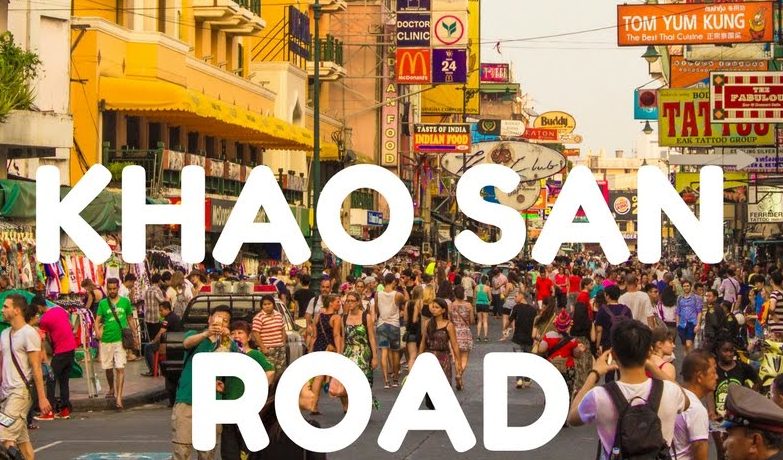
Welcome to Khoa San Road
“Khaosan” translates as ‘milled rice’, indicating that in former times the street was a major Bangkok rice market. However, historical records from when the road was first completed during the reign of Rama V indicate that none of the local residents were involved in the rice trade at the time. This suggests that rice trading in the area probably began earlier, in the early Rattanakosin period during the reigns of Rama I to Rama III. In the last 40 years, Khaosan Road has developed into a world-famous “backpacker ghetto”. It offers cheap accommodation, ranging from “mattress in a box”-style hotels to reasonably priced three-star hotels. In an essay on the backpacker culture of Khaosan Road, Susan Orlean called it “the place to disappear”. According to the Khao San Business Association, the road sees 40,000–50,000 tourists per day in the high season, and 20,000 per day in the low season.
Visitors to Khao San Road are diverse:
In this small area one can observe the interactions and groupings of disparate characters such as un-educated young Westerners on extended leave from affluent society, high school graduates on gap year travels, Israelis fresh out of military service, university students on holiday or sabbatical leave, young Japanese in rite-of-passage attire, ordinary holidaymakers, (ex-) volunteers from various organizations, and the like.
— Anders Sørensen, Annals of Tourism Research
It is also a base for travel: coaches leave daily for all major tourist destinations in Thailand, from Chiang Mai in the north to Ko Pha-ngan in the south. There are many relatively inexpensive travel agents who can arrange visas and transportation to the neighbouring countries of Cambodia, Laos, Malaysia, and Vietnam.
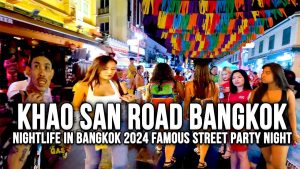 Khaosan Road at night
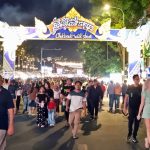
Khaosan shops sell handicrafts, paintings, clothes, local fruits, unlicensed CDs, DVDs, a wide range of fake IDs, used books, and other useful backpacker items. After dark, bars open, music is played, food hawkers sell barbecued insects and other exotic snacks for tourists, and touts promote ping pong shows. There are also cannabis shops.
The area is known internationally as a center of dancing, partying, and just prior to the traditional Thai New Year (Songkran festival) of 13–15 April, water splashing that usually turns into a huge water fight. One Thai writer has described Khaosan as “…a short road that has the longest dream in the world”.
A Buddhist temple under royal patronage, the centuries-old Wat Chana Songkram, is directly opposite Khaosan Road to the west, while the area to the northwest contains an Islamic community and several small mosques.